
Hall County Arrest Warrants Explained
Under Texas Code of Criminal Procedure Chapter 15, an arrest warrant is a written order telling an authorized person to take someone into custody. Hall County cases layer several pieces on top of that. A magistrate issues the order, the court file holds it, and a separate law-enforcement entry may exist. The local sheriff posts no public felony warrant roster. Start instead with the cause or citation number and the court named in any notice. A warrant is not a summons. It also differs from a bench warrant, which follows a missed court obligation rather than a new complaint. Ask the court for the exact process label and the next permitted step.
Chapter 15 Sets Hall County Arrest Warrant Rules
Chapter 15 builds the frame for every Hall County arrest warrant. It sets out what the order must contain and what the complaint must show first. The warrant names the accused by name or description, states the offense, and identifies the issuing magistrate. The complaint must be sworn and must allege facts supporting probable cause. Later provisions govern execution. They also give the accused the right to see the warrant on request. The chapter supplies a statewide execution framework, though it creates no public statewide name-search site. The official Chapter 15 text carries the full requisites and execution rules.
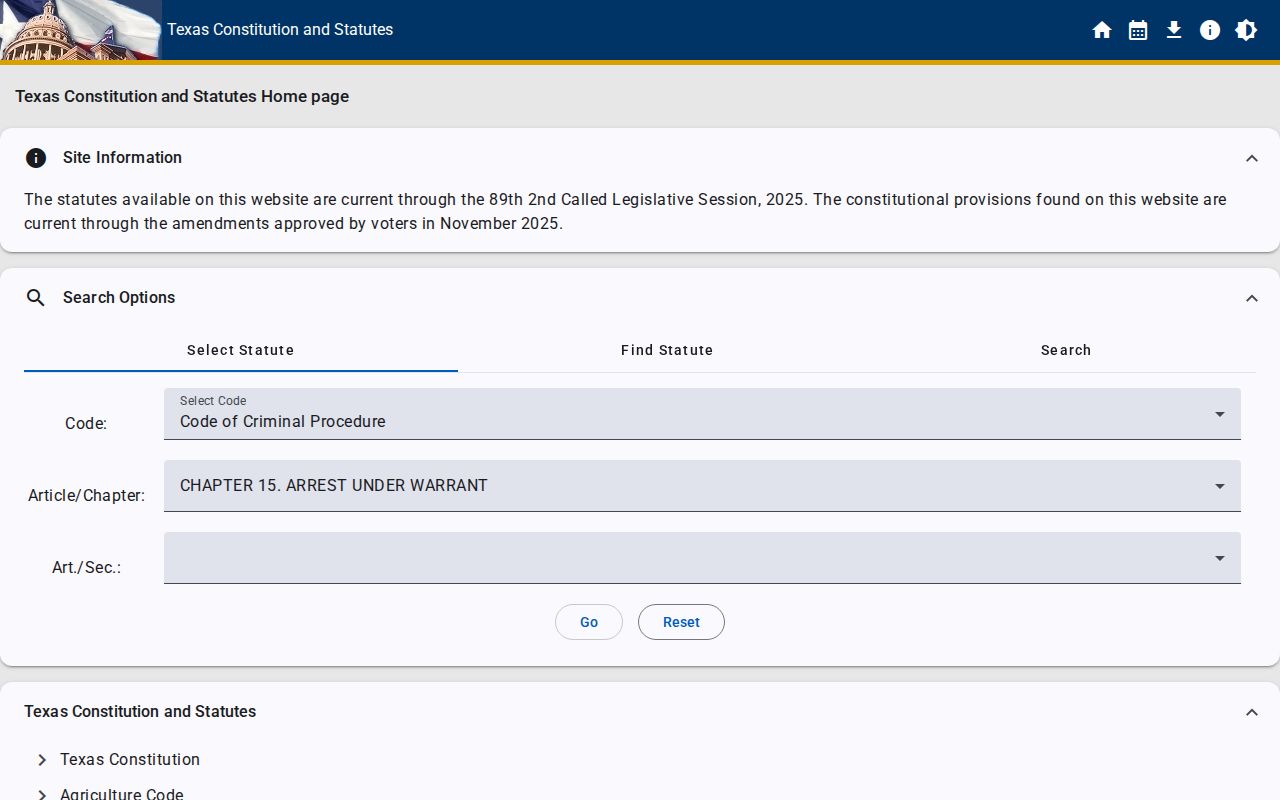
The linked statute sets statewide warrant requisites, not any Hall County case record or individual warrant.
Inside a Hall County Arrest Warrant
A released warrant or docket shows only some fields from the full file. Texas statutory requirements and the public bail-form portal back these general categories. Hall County publishes no local sample warrant and no local number pattern. Ask the clerk what a specific field means in that court's file.
| Order identifier | Warrant number or linked cause number if the office releases it. |
|---|---|
| Person description | Name or other identifying description required for the order. |
| Offense | The alleged offense tied to the complaint. |
| Affiant and complaint | The sworn probable-cause basis, if public. |
| Issuing magistrate | The court or officer authorizing the order. |
| Date and return | Issue date and any execution or return entry available. |
| Bond or custody | Bond type, amount, or commitment detail where released. |
A Hall County docket can omit sealed or investigative material, so ask the clerk what a displayed field means.
The 100th District Court Serves Hall County
The 100th District Court is Hall County's general-jurisdiction trial court for felony criminal cases. Its district also takes in Carson, Childress, Collingsworth, and Donley counties. The Hall County courtroom sits on the third floor of the courthouse at 512 W Main in Memphis. Judge Dale A. Rabe Jr. is named on the court page. Hearing requests go to 806-874-0122, though coordinator details vary across the page, so verify before relying on that line. The court's official page tells callers to have the case number, style, and hearing type ready when asking for a setting.
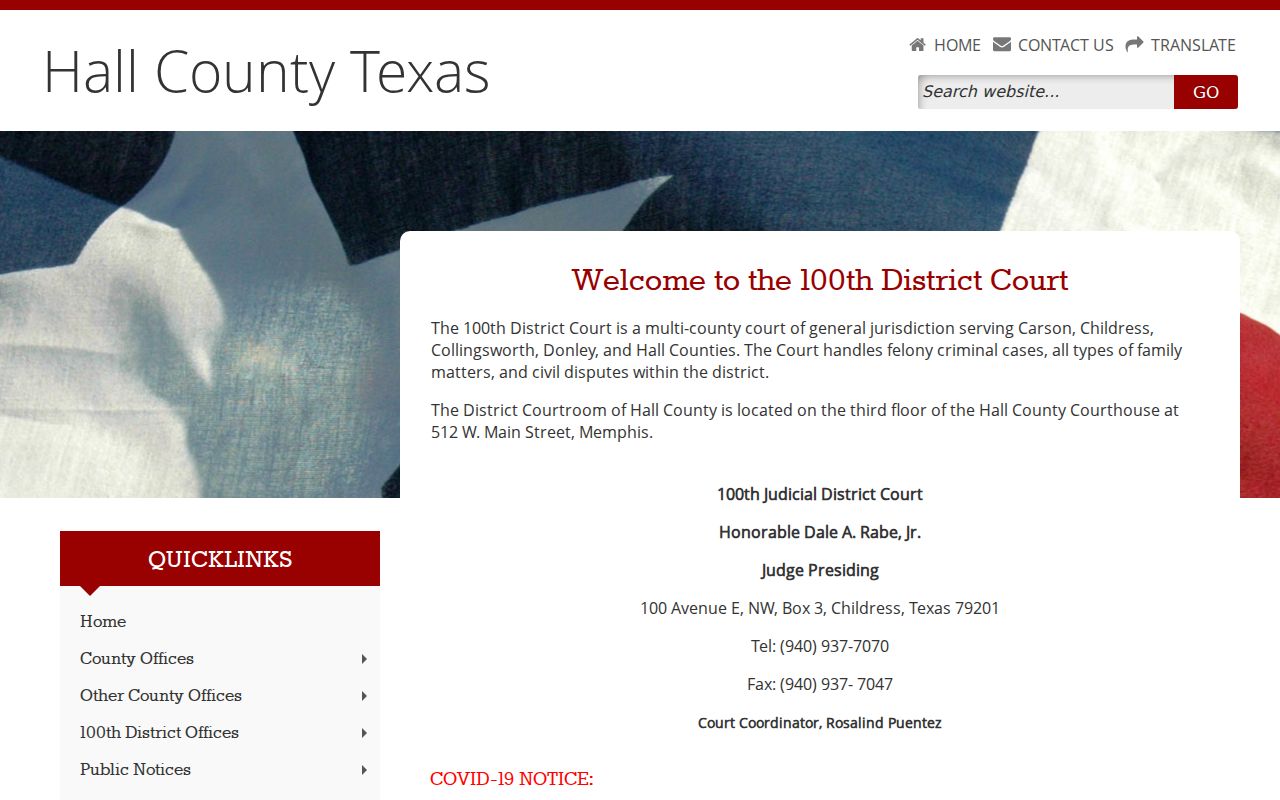
One court office may run a five-county docket, but the Hall County courtroom stays in Memphis.
Serving Arrest Warrants in Hall County
The issuing court authorizes any warrant. The clerk keeps the court records within access rules. The sheriff, police, or another authorized peace officer executes the order. The Hall County Sheriff's Office lists its business number as 806-259-2151, with 24-hour dispatch at 806-259-2636 and 806-259-2637. The Memphis Police Department is a separate local agency at 806-259-2916. Remember that a clerk docket is not a live operational entry in TCIC/TLETS. Texas DPS describes those systems as law-enforcement tools, not public name searches. One call may not answer every court or agency question, so plan on more than one.
Hall County District and County Clerk
512 W Main Street, Suite 8
Memphis, TX 79245
806-259-2627
Hall County Process Has Different Labels
An arrest warrant and a bench warrant differ in the court record and the reason for the order. A summons commands appearance. It is not the same custody order. A capias or capias pro fine runs through a different Texas court procedure. Hall County entries deserve their exact labels, not a blanket tag of "active warrant."
| Process | Basis | Question for the court |
|---|---|---|
| Arrest warrant | Probable-cause complaint. | Which magistrate issued it and what case number applies? |
| Summons | Notice to appear. | What appearance or notice is still due? |
| Bench warrant | Missed setting or court noncompliance. | Which court controls the next hearing or recall? |
Let the issuing court answer a Hall County label question, not a payment company or an unrelated list.
Comparing Arrest, Summons, and Bench Warrants
For a Hall County case, knowing the distinction routes your call and stops you from assuming a missed court date created a new charge. Chapter 15 governs arrest warrants. Justice court and municipal procedure appears in Chapter 45A. Each record has its own issuing authority and access limits. The Texas Judicial Branch notes that courts are not subject to the Texas Public Information Act the way executive agencies are. Judicial files follow Rule 12 and court orders instead. So a public docket may show a case while the warrant instrument or law-enforcement data stays restricted. That split is normal, and the clerk can explain what a Hall County file releases.
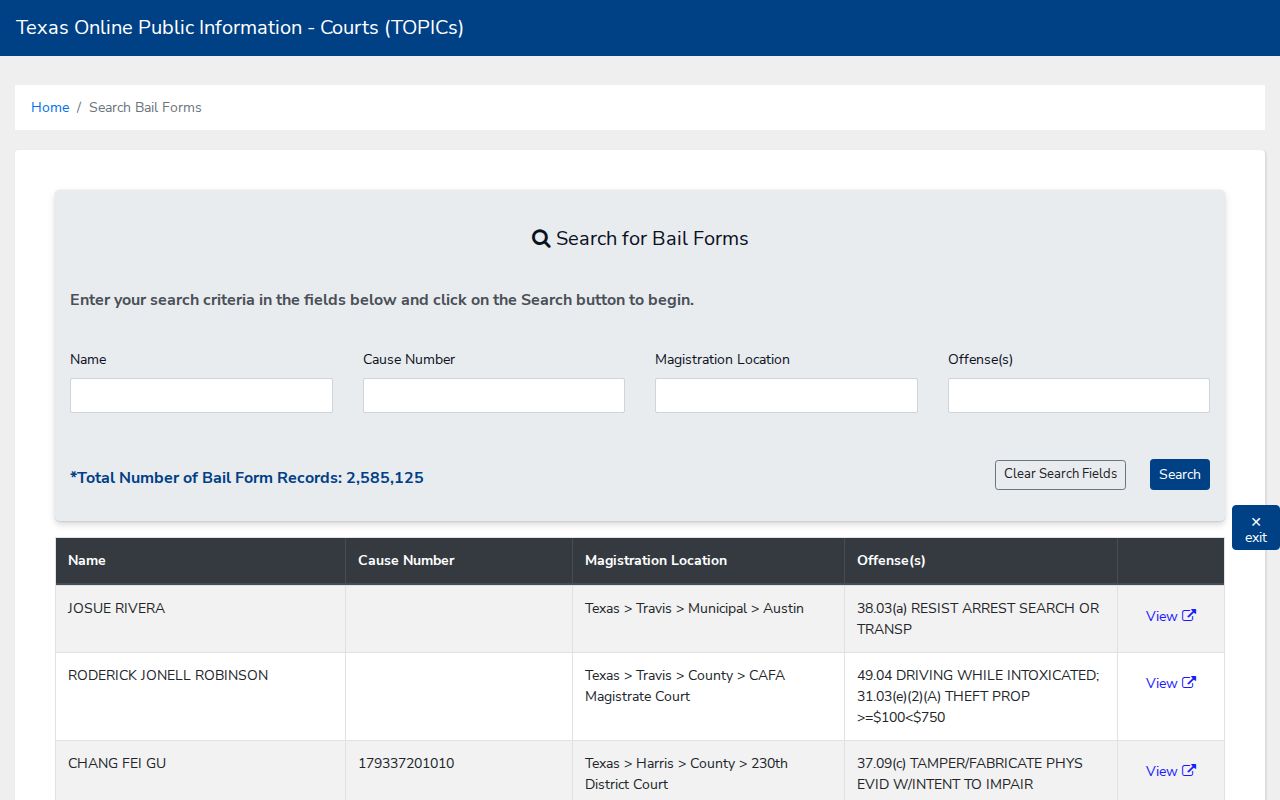
The completed-bail portal is statewide and warns that its submitted records are not complete or official court files.
Hall County's Bail Portal Is Not a Warrant List
The Texas Courts completed-bail search accepts Name, Cause Number, Magistration Location, and Offense(s). Results show those categories plus an action field. The portal's own notice warns that submissions may contain errors or omissions. It is not a Hall County warrant search. Treat the TOPICs bail-form search as a limited statewide record source only. Confirm any bond or case detail with the Hall County court handling the matter.
Hall County Sheriff Contacts Do Not Confirm Every Court File
Start with the Hall County Sheriff's Office if your question touches a warrant or a jail matter. The business line is 806-259-2151, and the office sits at 101 S 9th Street in Memphis, open weekdays from 8 a.m. to 5 p.m. Email goes to hallso@co.hall.tx.us, and dispatch answers at 806-259-2636 and 806-259-2637. Be clear about what you need. The sheriff keeps jail and service records, but a judge issues a warrant, so the sheriff cannot replace the clerk or the issuing court. The sheriff posts no public warrant roster. When you call, give the person's full name and a cause number if you have one, and ask whether your question is really about a court file. If it is, the clerk or the court named on the case paperwork is the right contact for Hall County.
If There's an Arrest Warrant for You
Pick up the phone before you drive anywhere. Call the court that issued the warrant and get the cause number, the bond amount if one is set, and word on whether a lawyer may reach the court ahead of an appearance. Hall County posts no universal bond schedule, no jail bond window, and no walk-in surrender desk, so a trip to the district courthouse may be the wrong first move for a JP or city case. A Texas attorney can weigh the record and talk through a hearing, a personal bond, a motion, or another court-approved route. Hang on to every filing, receipt, and written confirmation you collect. Ask the court, too, how a recall or compliance notice reaches the sheriff once the warrant is lifted.
Before appearing in person, call the issuing court or a lawyer to confirm the proper location and process. The local pages do not publish a surrender protocol.
The county overview's resolution steps lay out the Hall County court-first route and flag its contact gaps.